

Insights from Maragarita Makhanova
Waltham Collective was born out of a desire to unite emerging and established artists in North and East London. “There’s already a strong art community here, but many established artists dominate the scene. We wanted to bring a younger perspective and connect with artists who might not have had opportunities otherwise.”
By Alilya Narikbayeva
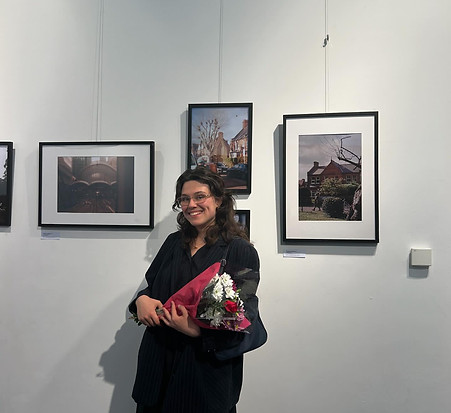

Margarita Makhanova didn’t always know she wanted to be a curator. It was a visit to the San Francisco Museum of Modern Art as a teenager that first sparked her fascination with contemporary art. “I couldn’t read all the signs as I didn’t know english well, so I started making up meanings for the artworks myself. That made me realise how much fun museums could be,” she recalls. That moment set her on a path that would lead to curating exhibitions and fostering inclusive artistic communities.
Starting Out in Curation
Many assume you need a degree in art history to become a curator, but Margarita says this isn’t the only route. She studied Creative Events Management at Arts University Bournemouth and later gained curatorial knowledge through the NODE Center for Curatorial Studies. “I thought you had to have an art history degree to call yourself a curator, but I realised that wasn’t true. What mattered most was creating projects and making them happen.”
Her advice to aspiring curators? Just start. “It’s scary to do something by yourself, but that’s why we created the Waltham Collective, to support each other. And honestly, just be friends with artists. That’s how the best projects come to life.”
Waltham Collective: Building a Community for Artists
Waltham Collective was born out of a desire to unite emerging and established artists in North and East London. “There’s already a strong art community here, but many established artists dominate the scene. We wanted to bring a younger perspective and connect with artists who might not have had opportunities otherwise.”
A key part of the Collective’s mission is accessibility. Margarita’s curatorial approach centres on engaging the audience in a meaningful way. “An exhibition isn’t just about showing art—it’s about making people feel something, making them part of the experience. That’s why we include public programming like workshops and interactive elements.”
The Next Exhibition: ‘Feel the Home’
Waltham Collective’s upcoming exhibition taking place in May,, ‘Feel the Home,’ set to open in May at the VINs Gallery, is an ambitious project that reimagines the traditional gallery space. “I don’t want people to just walk into a white-walled room,” Margarita explains. “I want to create an experience. The gallery will be transformed into a translucent home, and artists are invited to ‘fill’ its spaces with their work.”
For Margarita, the most rewarding moments come from seeing the impact her exhibitions have on visitors. “We had a feedback book at our last show, and reading people’s responses made everything worth it. Seeing that our ideas were understood, that the art spoke to them—that’s what keeps me going.”
As Waltham Collective continues to grow, Margarita is focused on expanding its reach and providing more opportunities for artists to showcase their work. “We just announced an open call, and within 24 hours, we already had three submissions. That kind of excitement and engagement makes me believe in what we’re doing.”
For those looking to step into curating, Margarita’s advice is simple: “Be fearless, be curious, and don’t be afraid to make mistakes. Curating is about creating connections—between artists, audiences, and ideas. And that’s something you can start doing right now.”
For more details on Waltham Collective and their upcoming exhibition, follow their latest updates online.
Margarita’s Book Recommendations for Emerging Artists and Curators
For those looking to break into curating or the art world, Margarita believes learning never stops. Alongside hands-on experience, she recommends reading widely to understand different perspectives on curating, programming, and art’s role in society.
Here are four books she suggests for emerging curators and artists:
📖 1. Building Human Relations Through Art: Belgrade Art Collective ‘kart from 1990 to Present’ – Edited by Seda Yıldız
A deep dive into performance-based art and public programming, told in an engaging and conversational way.
📖 2. Ways of Curating – Hans Ulrich Obrist
The perfect introduction to curating. Obrist’s journey into curation, starting with an exhibition in his own kitchen proves that curators can think outside traditional gallery spaces.
📖 3. Curating Capitalism: How Art Impacts Business, Management, and Economy – Pierre Guillet de Monthoux
Explores the relationship between art and capitalism, questioning how artists and curators can work within (and against) commercial structures.
📖 4. Arts and Cultural Programming – Gaylene Carpenter & Doug Blandy
For those interested in the role of public programming, this academic read offers different perspectives on how to engage audiences through exhibitions and events.
Margarita’s Tips for Aspiring Curators
From her own journey, Margarita knows that curating isn’t just about having an art history degree, it’s about storytelling, collaboration, and creating meaningful experiences.
Find a concept that resonates – “Think beyond just ‘art on walls.’ What emotion or experience do you want people to have?”
Work with artists, not just select them – “Give them freedom to interpret the theme, you might end up with something even better than expected.”
Make exhibitions interactive – “People should engage with the space, not just observe it.”
Be resourceful – “You don’t need a big budget to curate. Independent spaces, collaborations, and strong ideas matter more.”
Keep learning – “Every exhibition teaches you something new, and reading helps shape how you see the role of a curator.”
Her next exhibition, “Feel the Home” (May 2–5, 2025, VINs Gallery), will experiment with turning a gallery into a conceptual home, letting artists define what ‘home’ means through their work.
Want to get involved? Check out @walthamcollective on Instagram for updates and open calls.